GEN 1.5 Aircraft instruments, equipment and flight documents
1. General
- VHF RTF with Appropriate Frequencies available
- VOR receiver
- DME
- ILS
With the exception of State aircraft, there are no exemptions to the requirements for the carriage and operation of 8.33 kHz spacing radio equipment above FL195 in the Shannon FIR/UIR.
Non-equipped flights must flight plan to operate below FL195.
Exemptions for State aircraft, from the mandatory carriage of 8.33 kHz spacing radio equipment are described in ENR 1.8
Aircraft operated under IFR in Class C and Class G airspace are required to have 8.33 kHz spacing radio equipment.
Aircraft operated under VFR in Class C and Class G airspace are required to have 8.33 kHz spacing radio equipment if communications are performed on 8.33 kHz spaced frequency assignments.
Exemptions from mandatory carriage of 8.33 kHz aircraft radio equipment are described in ENR 1.8
2. RVSM
- aircraft for which an approval is sought have the vertical navigation performance capability required for RVSM operations through compliance with the criteria of the RVSM minimum aviation system performance standards (MASPS);
- they have instituted procedures in respect of continued airworthiness (maintenance and repair) practices and programmes; and
- they have instituted operational procedures and a programme of flight crew training so that they have an in depth knowledge of the criteria for operating in RVSM airspace and this should include both initial and recurrent training
- Equipment Requirements and Minima;
- Flight Planning;
- Pre-Flight, In-Flight and Post-Flight Procedures;
- Contingencies;
- TCAS/ACAS Alerts;
- R/T Phraseology;
- Height Monitoring Requirements;
- Loss of thrust on one or more engines necessitating descent;
- b. Loss of one or more altimetry systems;
- c. Failure of all automatic altitude control systems;
- d. Failure of any other equipment that could affect the ability of the aeroplane to maintain flight as cleared.
For oceanic and remote area RVSM application, where continuous direct controller-pilot communication may not always be possible, a range of contingencies have been considered which allow independent action by flight crews. In general they permit crews, in exceptional circumstances, to deviate from assigned clearances by selecting flight levels and/or tracks where other aeroplanes are least likely to be encountered. During such deviations crews are required to make maximum use of aeroplane lighting and to transmit relevant information on all appropriate frequencies, including the distress and emergency frequency. Once contact with ATC has been re-established, the crew will be assisted and issued with new clearances as required. Offset track procedures may be permitted if an encounter with turbulence is considered to be due to wake vortex in accordance with PANS ATM (Section 15.2.4).
Procedures for dealing with TCAS/ACAS Alerts and Warnings are contained in Procedures for Air Navigation Services Aircraft Operations (PANS OPS, ICAO Doc 8168), Part 3, Section 3, Chapter 3. Where fitted, TCAS should be operated in the TA/RA mode during all operations. Any TA/RA should be treated as genuine. Flight crews should respond and report them as specified in their Operations Manual.
Phraseology associated with RVSM operations has been developed for European wide use. All flights must use this phraseology whilst operating, or intending to operate, between FL290 and FL410 inclusive in the Shannon FIR/UIR, NOTA and SOTA. Aircraft operators are reminded that, within Irish airspace, when responding to ATC the pilot is to append the call sign at the end of the message and not at the beginning. ATC are to use the controller-controller RVSM phraseology for co-ordination between Air Traffic Service Units (ATSUs). In the event of ATC being advised by the pilot that the aircraft is no longer capable of RVSM operations, it is particularly important that the first ATSU that is made aware of the failure generates the appropriate co-ordination, e.g. the pilot calls for start-up and declares 'unable RVSM due equipment' and the airport ATSU then passes this message on to the first Air Traffic Control Centre involved with the flight.
Note 1: Operators of Non-RVSM Approved aircraft are not to enter 'W' in item 10 even with this specific exemption.
Note 2: Having an RVSM Exemption does not confer any right to enter RVSM airspace as GAT unless specifically agreed by the appropriate ATC agency on the day. Any such penetration of RVSM airspace must be subject to the prevailing traffic conditions and controller workload.
When Non-RVSM aircraft are ready to enter RVSM airspace, the appropriate clearance is to be obtained from ATC. Note that, due to the need to provide 2000 ft separation, controllers need to co-ordinate the flight with other RVSM approved aircraft. These flights therefore create extra workload and a slight delay in receiving such clearances should be anticipated. It would therefore be helpful if pilots can provide as much notice as possible prior to requesting flight levels above FL280. Pilots must comply with any requirements stated in the RVSM Exemption unless otherwise instructed by ATC. Pilots are also reminded to include their Non-RVSM status (call sign: NEGATIVE RVSM) in the initial call on any frequency within RVSM airspace and subsequent frequency changes, when requesting level changes pertaining to flight levels in RVSM airspace and in all read backs to flight level clearances pertaining to flight levels in RVSM airspace.
On behalf of ICAO the EUROCONTROL Agency acts as the RMA. The information which will be obtained through the monitoring programme on aircraft compliance status and measured height keeping performance will be combined with the information available from monitoring agencies in other regions. The RMA will support operators and approval authorities on any issue related to RVSM approval and monitoring. The RMA will require information on the aircraft which are intended to operate in EUR RVSM airspace, and which will, therefore, need to be monitored on a periodic basis as part of the continuing safety assessment. To this end the RMA will also be in contact with State approval authorities. The RMA is based at the EUROCONTROL headquarters in Brussels, Belgium. The RMA will ensure the continuous operation of the monitoring systems and will manage the measured height keeping performance data. The RMA will identify any height deviations that are outside the specifications of the ICAO RVSM performance requirements, and will follow-up as required.
Prior to the implementation of RVSM in the EUR region an independent study concluded that the 'probability of hazardous encounters with wake vortices are not expected to increase but that nuisance encounters would increase'. Since August 2000 EUROCONTROL has been collating wake vortex encounters in the European airspace at FL 245 and above. These encounters have been subject to further independent analysis which has confirmed the findings of the above mentioned study. It is vital, however, that pilots continue to provide reports of wake vortex encounters in RVSM airspace. Any pilot who encounters a wake turbulence incident when flying in EUR RVSM airspace or within an adjacent RVSM transition area should ensure that a detailed report is provided to EUROCONTROL and State Regulation Authorities.
ICAO Document 7030 'Regional Supplementary Procedures' recognises wake turbulence as a factor in European and North Atlantic RVSM operations. In the North Atlantic, due to the special nature of the airspace and frequent poor communications, procedures have been developed which allow action by flight crews independent of ATC involvement. These procedures are not applicable to EUR RVSM airspace, where direct pilot/controller communication exists together with sufficient radar coverage to enable ATC to manage required flight deviations. In addition the vertical separation between aircraft can be increased tactically should this be necessary.
- inform ATC as soon as possible ('UNABLE RVSM DUE TURBULENCE');
- obtain a revised ATC clearance prior to initiating any deviation from cleared route or flight level;
- where such revised ATC clearance could not be obtained prior to such a deviation, obtain a revised clearance as soon as possible thereafter.
The ATC controller:
- shall establish either an appropriate horizontal separation or an increased vertical separation of 600 M (2000ft);
- shall, to the extent possible, accommodate the pilot's request for flight level and/or route changes and pass traffic information as required;
- confirm that the pilot is ready to resume RVSM operations ('REPORT READY TO RESUME RVSM').
3. Performance Based Navigation (PBN)
- Implementation of RNAV and RNP operations (where required) for en-route and terminal areas and;
- Implementation of Approach Procedures with Vertical guidance (APV), either Barometric Vertical Navigation (Baro-VNAV) and/or augmented GNSS, including Lateral Navigation (LNAV) only minima for all instrument runway ends, either as the primary approach or as a back-up for precision approaches by 2016;
- Implementation of straight-in LNAV only procedures (as an exception to 2. above) where the fleet is not APV capable.
Manual or automated notification of an aircraft’s qualification to operate along an ATS route, on a procedure or in airspace is provided to ATC via the Flight Plan. Flight Plan procedures are addressed in Procedures for Air Navigation Services — Air Traffic Management (PANS-ATM) (Doc 4444).
The NAVAID Infrastructure refers to ground- or space-based NAVAIDs. Ground-based NAVAIDs include DME and VOR. Space-based NAVAIDs include GNSS elements as defined in Annex 10 — Aeronautical Telecommunications
The airworthiness element consists of ensuring that the aircraft meets the aircraft eligibility requirements for the functions and performance requirements defined in the navigation specifications (or other referenced certification standards) as well as the installation meeting the relevant airworthiness standards. The airworthiness element may also include applicable non-navigation equipment required to conduct the operation such as communications and surveillance equipment (US 14 CFR / EASA CS Part 25).
For the continued airworthiness operational approval, the operator is expected to be able to demonstrate that the navigation system will be maintained compliant with the type design. For navigation system installations there are few specific continued airworthiness requirements other than database and configuration management, systems modifications and software revisions but the element is included here for completeness and consistency with other CNS / ATM operational approvals e.g. RVSM. The continued airworthiness element of the operational approval is not directly addressed in the PBN Manual since it is inherent in the aircraft airworthiness approval through the airworthiness requirements (US 14 CFR / EASA CS Part 25).
The operational approval assessment takes account of the following:
- Aircraft eligibility and airworthiness compliance;
- Operating procedures for the navigation systems used;
- Control of operating procedures (documented in the operations manual);
- Flight crew initial training and competency requirements and continuing competency requirements.
- Dispatch training requirements;
- Control of navigation database procedures. Commercial operators need to have documented procedures for the management of navigation databases. These procedures will define the data validation procedures for navigation databases and the installation of new databases into aircraft so that they remain current with the AIRAC cycle; and
- Continued Airworthiness. Operators should have procedures for assessing and incorporating instructions for continued airworthiness and maintenance or inspection information concerning system modifications, software revisions, etc.
Note: - This volume of airspace is referred to as the ‘MNPS airspace’
- The standard deviation of lateral track errors shall be less than 11.7Km (6.3NM);
- The proportion of the total flight time spent by aircraft 56Km (30NM) or more off the cleared track shall be less than 5.3x10⁻⁴; and
- The proportion of the total flight time spent by aircraft between 93 and 130Km (50 and 70 NM) off the cleared track shall be less than 1.3x10⁻⁴
Note.-Guidance material of use to those involved in the initial achievement and continued maintenance of the navigation capability set forth in 3.7.1.1.2 has been issued by ICAO under the title North Atlantic Operations Manual (NAT Doc 007) and will be supplemented and updated as required and as new material becomes available
Note.- The performance -based Navigation (PBN) Manual (Doc 9613) provides guidance on aircraft approval, operations and maintenance programmes for initial achievement and continued compliance with RNAV 10 (Designated and Authorised as RNP) 10 and RNP 4
Note. - RNP 10 time limits are discussed in (DOC 9613) Part B, Volume II Chapter 1.
Note 1.- SOTA is defined as that airspace from DINIM (510000N 0150000W) - LESLU (510000N 0080000W) - 483000N 0080000W - BEDRA (490000N 0150000W) to DINIM (510000N 0150000W)
Note 2. - BOTA is defined as that airspace from 483400N 0084500W - 483000N - 0080000W - 450000N 0080000W - 450000N 0084500W to 483400N 0084500W.
The requirements for MNPS are set out in the Guidance concerning Air Navigation in and above the North Atlantic MNPS Airspace (NAT Doc 007) (available at http://www.paris.icao.int)Refer to MNPS
Background
Attention is drawn to the fact that aircraft which are not RNAV approved, may be subject to less optimal routeings, track mileage, fuel burn, and increased delays.
Basic Functions
- Capability to follow a desired ground track with reliability, repeatability and predictability, (including optional curved path); and
- Where vertical profiles are included for vertical guidance, use of vertical angles or specified altitude constraints to define a desired vertical path.
- Display and indication of both the required and the estimated navigation system performance;
- Monitoring of the system performance and alerting the crew when RNP requirements are not met; and
- Cross track deviation displays scaled to RNP, in conjunction with separate monitoring and alerting for navigation integrity.
Background
RNP AR APCH is a “high-end” instrument approach navigation specification. RNP AR provides an added level of assurance over standard operations and as the designation indicates, a special authorisation is required. ICAO has identified specific instrument approach design criteria in the RNP AR Manual (Doc 9905) and whilst criteria in this and the PBN Manual cater today for approach operations, work is underway to update both to address Departures. The advanced features of RNP AR include operations with navigation accuracy less than 0.3 NM, use of Radius to Fix (RF) Path Terminator in all flight segments and reduced obstacle assessment criteria reflecting the assurance accounted for in a Flight Operations Safety Assessment (FOSA).
| Airspace Application | Navigation Specification | Applicable Regulatory Guidance |
|---|---|---|
| Oceanic & Remote | RNAV 10 | FAA order 8400.12A / EASA AMC 20- 12 |
| RNP 4 | FAA order 8400.33 / EASA Rule making Task No. MDM.062 (JAA CNS/ATM SG pp045) | |
| RNP 2 | To Be Developed | |
| Advanced RNP | ||
| Continental En-route | RNAV 5 | FAA AC 20-138B, AC 90-96A / EASA AMC 20-4 |
| RNAV 2 | FAA AC 90-100A | |
| RNAV 1 / P-RNAV | FAA AC 90-100A / JAA TGL 10 Rev 1 | |
| RNP 2 | To Be Developed | |
| Advanced RNP | To Be Developed | |
| RNP 0.3 | To Be Developed | |
| Terminal Airspace | RNAV 5 | FAA AC 20-138B, AC 90-96A / EASA AMC 20-4 |
| RNAV 2 | FAA AC 90-100A | |
| RNAV 1 / P-RNAV | FAA AC 90-100A / JAA TGL 10 Rev 1 | |
| RNP 1 | FAA AC 20-138B, AC 90-105 | |
| Advanced RNP | To Be Developed | |
| RNP 0.3 | To Be Developed | |
| Approach Operations | RNAV 1 / P-RNAV | FAA AC 90-100A / JAA TGL 10 Rev 1 |
| RNP 1 | FAA AC 20-138B, AC 90-105 | |
| Advanced RNP | To Be Developed | |
| RNP APCH (Initial, Intermediate and Missed Approach Segments, with or without RF legs) | FAA AC 20-138B, AC 90-105 / EASA AMC 20-27 | |
| RNP APCH (Final Approach Segment of instrument approach procedure, designed to LNAV and/or LNAV/VNAV minima) | FAA AC 20-138B, AC 90-105 / EASA AMC 20-27 | |
| RNP APCH (Final Approach Segment of instrument approach procedure, designed to LP or LPV minima) | FAA AC 20-138B, AC 90-107 / EASA NPA 2009-04 (AMC 20-28) | |
| RNP AR Operations | FAA AC 90-101A / EASA AMC 20-26 | |
| RNP 0.3 | To Be Developed |
ICAO Doc 7030 Regional Supplementary Procedures detail the contingency procedures.
4. RNAV (GNSS) Instrument Approach Procedures
To be developed
5. MNPS
- The standard deviation of lateral track errors shall be less than 6.3 NM;
- The proportion of the total flight time spent by aircraft 30 NM or more off the cleared track shall be less than 5.3 x 10⁻⁴;
- The proportion of the total flight time spent by aircraft between 50 NM and 70 NM off the cleared track shall be less than 13 x 10-5.
- Aircraft must be operated so that lateral deviations from track remain less than 12.6 NM for at least 95 per cent of the time the system is required for navigation;
- The navigation system must demonstrate a continuing capability to keep lateral deviations from cleared track in excess of 30 NM to less than 53 per 100 000 flight hours in the system; and
- Keep lateral deviations between 50nm and 70 NM from cleared track, to less than 13 per 100 000 flight hours in the system.
- The flight MUST have prior approval for operations in Irish MNPSA;
- The approved aircraft minimum navigation installation MUST be serviceable and MUST have been checked for accuracy prior to entry into MNPSA;
- Whilst in MNPSA the approved operating procedures MUST be adhered to. Except in emergency, diversions from the ATC cleared track MUST NOT be made without prior approval of the controlling ATC Unit;
- If subsequent un-serviceability reduces the navigational capability below the required minimum for MNPS operations after entry into MNPS Airspace then the controlling ATC Unit MUST be advised so as to allow for any adjustments of separation from adjacent aircraft;
- There MUST be a high standard of supervision, monitoring and cross checking of data inserted into automatic navigation system to prevent large errors arising from erroneous waypoint entries;
- There MUST be a high standard of co-ordination with ATC Units to ensure that misunderstandings over the route to be flown do not occur.
- Two fully serviceable Long Range Navigation Systems (LRNS). A LRNS may be one of the following:
- One Inertial Navigation System (INS);
- One Global Navigation Satellite System (GNSS); or
- One navigation system using the inputs from one or more Inertial Reference System (IRS) or any other sensor system complying with the MNPS requirement.
- Each LRNS must be capable of providing to the flight crew with a continuous indication of the aircraft position relative to desired track.
- It is highly desirable that the navigation system employed for the provision of steering guidance is capable of being coupled to the auto-pilot.
Note 1: Only two GNSSs currently exist: the Global Positioning System (GPS) and the Global Orbiting Navigation Satellite System (GLONASS).
Note 2: A GPS installation must be approved as follows:
If the two required LRNSs are both GPS, they must be approved in accordance with FAA Notice 8110.60 or equivalent JAA or national documentation and their operation approved in accordance with FAA HBAT 95-09 or equivalent national or JAA documentation. If GPS serves as only one of the two required LRNSs, then it must be approved in accordance with FAA TSO-C129 as Class A1, A2, B1, B2, C1 or C2, or with equivalent national or JAA documentation.
Note 3: Equivalent approved material for GLONASS is under development and must be available prior to approval of any GLONASS equipped aircraft for MNPS operations.
RVSM applies in the MNPS Area of the Shanwick Oceanic Control Area from FL290 to FL410 inclusive. Aircraft using this Area are required to have a height keeping performance capability as defined in the appropriate ICAO Documents/JAA Temporary Guidance Leaflet. In order to ensure that the overall standard of required height keeping is being achieved within RVSM airspace a technical height keeping monitoring program has been established in accordance with ICAO guidance. In order to ensure that the required altimetry standards are being observed within RVSM airspace, a technical height keeping monitoring programme has been initiated. For the task of monitoring technical height keeping accuracy, a hybrid system comprising of a Height Monitoring Unit (HMU) and GPS Monitoring Systems (GMS) is employed.
If the flight is certified as being in compliance with Minimum Navigation Performance Specification (MNPS) and intends to operate in MNPS airspace, for any portion of the flight, the letter 'X' shall be inserted after the letter 'S' in Item 10 of the flight plan to indicate that the flight has been approved for operations within the Minimum Navigation Performance Specification Airspace (MNPSA). It is the Captain's responsibility to ensure that specific approval has been given for such operations by the State of Registry of either the aircraft or of the operator.
6. Use of Instrument Landing System (ILS) facilities in Ireland
6.1 Introduction
The purpose of this section is to provide guidance on the limitations of ILS and to advise pilots of precautions to be taken during operational use.
6.2 General
- they are only used inside specific coverage sectors;
- the signal-in-space is being adequately protected;
- due account is taken of any warnings or differences promulgated by NOTAM or contained in AIP Ireland.
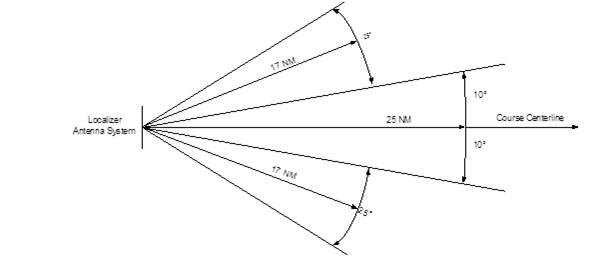
6.3 Localizer
- out to 25 NM within ± 10º of the front course centreline;
- out to 17 NM within ± 35º of the front course centreline;
6.4 Glidepath
- Coverage sectors of 8° in azimuth each side of the Localiser centre-line to a distance of at least 10 nm from threshold;
- Vertical Coverage is provided from 0.45Ø up to 1.75Ø above the horizontal where Ø is the promulgated Glide Path angle.
This equates to coverage from 1.35° to 5.25° above the horizontal for a 3° Glide Path.
6.5 Protection of ILS guidance signals
6.6 ILS/DME
Distance Measuring Equipment (DME) is frequency paired with ILS channels to supplement or replace range information provided by ILS marker beacons. All range information from ILS/DME is zero referenced to the runway threshold but the use of such an ILS-paired DME outside of a promulgated procedure may result in erroneous distance information and/or corrupt or erroneous identification coding.
6.7 Maintenance
6.8 Further Information
Enquiries regarding the use of Instrument Landing Systems in Ireland should be addressed to:
Aeronautical Services Department
Safety Regulation Division
Irish Aviation Authority
The Times Building
11-12 D’Olier St
Dublin 2
D02 T449